If you serve on an HOA board or manage associations, you already know the pattern: open forums stay quiet, email threads turn personal, and the same three voices dominate. Meanwhile the treasurer is watching water, sewer, and irrigation line items drift upward—and when you ask the community for leads, you get shrugs. Nobody wants to be the neighbor who “caused trouble,” and nobody wants to be quoted in the minutes.
That silence is expensive. It delays repairs, inflates common-area utilities, and eventually shows up in dues, special assessments, or deferred reserve projects.
One multi-unit HOA ran anonymous pulse check-ins on Wellness Pulse, turned that signal into leak and irrigation fixes, and proved the payoff on the water bill: about $4,179 in water charges they did not pay on the March 2026 statement (versus the same effective rate at the prior cycle’s higher usage).
How anonymous pulse led to this bill outcome
- Pulse launch (January 2026). The board sent recurring, architecturally anonymous pulse surveys through Wellness Pulse—short check-ins, not a one-off complaint form—asking what was working and what needed attention in common areas and utilities.
- Signal boards could use. Residents named where water was being wasted (stuck valves, irrigation after rain, garage-level noise) because replies could not be traced back to a unit.
- Repairs. Property management made a short fix list from what residents kept reporting—without knowing which unit said what. Vendors checked those spots and repaired what was wrong. The work order never needed a name.
- Proof. The district’s next full billing cycle on the statement (March 2026 read) shows usage down sharply; the math on the current water charges line implies roughly $4,179 avoided versus billing at January’s volume.
Pulse = ongoing rhythm of feedback. That is what changed the board’s visibility between the January and March reads. See how Wellness Pulse works · Sign up
The board was doing everything “by the book”
The association had the usual stack of worries: parking gripes, noise, slow work orders, landscaping debates. Meetings stayed civil. Vendors got paid. But master-meter water kept feeling wrong. Usage was high enough that directors asked management to “keep an eye on it,” which really meant: walk the property when there is time, hope someone complains, and otherwise wait for the next district read.
That is not negligence; it is normal HOA operations without a confidential channel. Residents who hear running water behind a garage wall, see a stuck irrigation valve, or notice a wet strip along a planter often stay silent. Calling it out can feel like accusing another owner—or the board—of neglect.
January 2026: anonymous pulse surveys on Wellness Pulse
In January 2026, the board and management turned on Wellness Pulse for the community’s anonymous pulse program: short, repeating check-ins (pulse cadence) instead of a single annual survey. Each pulse invited honest input on common areas, safety, maintenance, utilities, and amenities—with no way to tie answers to a specific owner, by design.
That is the product difference: pulse keeps the channel open so small problems surface before the next board meeting. The shift showed up immediately in the content of responses—not just scores, but location-specific clues: a riser that never fully closed, irrigation cycling after rain, a garage level where water noise never stopped. Management turned those clues into work orders; vendors fixed what they found. No one had to sign their name to a complaint. Pulse did not replace inspections—it aimed them.
What changed on paper: six billing cycles from the district statement
The charts and table below are independent meter evidence from the water district—but the timing lines up with pulse-driven work: from mid-2025 through the January 2026 cycle, billed usage stayed above 2,000 units every period. After the association acted on themes that came in through Wellness Pulse anonymous pulse in that window, the March 2026 read landed at 1,501 units—about 1.12 million gallons for the period versus roughly 1.53 million gallons on the January 2026 cycle.
Compared with January’s 2,049 units, March’s 1,501 units is about a 27% reduction—right around the one-quarter drop boards care about when they model next year’s budget.
About $4,179 back in the association’s pocket (water line only)
The March 20, 2026 statement shows current water charges of $11,447.84 for this read (1,501 units over 58 days—roughly two months on the meter). The prior billing cycle on the statement’s history was 2,049 units. If that same bill had been priced at the same effective dollars per unit—a straight scaling from the actual water line, before tiers and quirks—then at 2,049 units the water charges would have been about $15,627. The difference is $11,447.84 × (548 ÷ 1,501) ≈ $4,179 in water charges avoided on this period alone because usage dropped. (Miscellaneous line items such as the small adjustment on the statement are excluded; your district’s full rate design may differ slightly.)
After anonymous pulse: billed volume (gallons per cycle, district data)
These charts use the statement’s usage (gallons) column—the utility’s own numbers. The steep drop on the right is the March 2026 cycle, after pulse-backed repairs; the vertical scale starts above zero so the change in volume is easy to see.
Total gallons billed per cycle
Same data — volume trend (gallons)
Jan vs Mar 2026 — gallons billed (after Wellness Pulse pulse & fixes)
| Read date | Usage (units) | Usage (gallons) | Gal/day (per unit) | Days |
|---|---|---|---|---|
| 03/2026 | 1,501 | 1,122,823 | 128 | 58 |
| 01/2026 | 2,049 | 1,532,754 | 158 | 64 |
| 11/2025 | 2,254 | 1,686,104 | 186 | 60 |
| 09/2025 | 2,278 | 1,704,057 | 182 | 62 |
| 07/2025 | 2,476 | 1,852,171 | 204 | 60 |
| 05/2025 | 2,345 | 1,754,177 | 190 | 61 |
Source: Contra Costa Water District, Oak Road Station, statement dated March 20, 2026. Download the PDF statement.
Excerpts from the actual statement
Cropped from the CCWD PDF (not retyped)—so readers see official Contra Costa Water District letterhead, not a recreation. The full PDF above has complete pages; crops omit the payment stub.

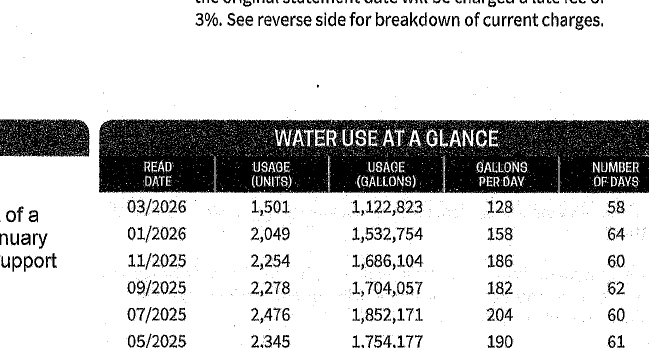
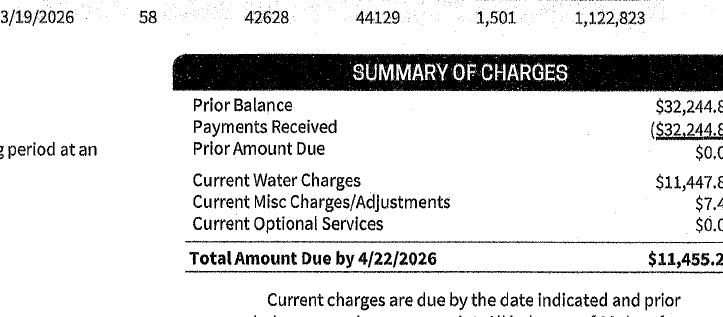
What that means for dues. This is the other half of the Wellness Pulse story: anonymous pulse is not just sentiment—it produced operational detail that led to measurable gallons and dollars. On this statement, the current water charges line implies roughly $4,179 less for the period than at the January cycle’s volume if usage had stayed high. Treasurers can take that to the board when someone asks if pulse feedback is “soft.” Broader point: roughly 25% more usage implies roughly 25% more water cost when the effective rate is stable—money that stays in reserves when leaks get fixed early.
Why other HOAs should pay attention
You do not need a scandal to justify Wellness Pulse. You need earlier signal—the kind that anonymous pulse delivers on a steady cadence—on problems that inflate insurance claims, vendor callbacks, and utility bills. Pulse does not replace inspections or engineering; it aims your limited budget where residents already sense failure, without forcing them to go on the record in a meeting.
Sound familiar? Your association might be ready if…
- Open comments and surveys stay generic while common-area costs climb.
- Owners hesitate to report issues that could embarrass another household.
- The board wants audit-friendly action without “who said it” drama in the minutes.
- Management needs themes across dozens or hundreds of doors—not one-off emails.
Give your community a voice the board can actually use
Wellness Pulse is built for anonymous pulse: responses cannot be tied to individuals, so you get honest operational detail—the sort that showed up as leak and irrigation fixes here—and boards and PMs can turn it into work orders, vendor scopes, and budget relief. The meter does not care about storytelling; it only moves when something real changes. In this case, pulse came first; the numbers moved after.
Run anonymous pulse on Wellness Pulse at your HOA
Put recurring, truly anonymous pulse surveys in front of owners and see what your treasurer’s utility lines have been missing—before the next rate increase shows up on the bill.
Get started How it worksQuestions & answers
How can anonymous surveys help HOAs cut water or utility costs?
Residents often avoid naming leaks, irrigation problems, or common-area waste in public meetings. A short anonymous pulse can surface patterns safely so boards prioritize inspections and repairs before the next billing cycle.
What is Wellness Pulse for HOA boards?
Wellness Pulse is an anonymous pulse tool boards can use for recurring quick checks on maintenance, utilities, noise, and satisfaction—without tying answers to unit owners in a way that chills honest input.
Does this HOA story claim guaranteed savings for every association?
The article describes a composite narrative tied to real district statement excerpts and usage tables for illustration. Actual savings depend on property condition, rates, and actions taken; the value is the workflow: listen anonymously, act, verify on the bill.